In a scandal that is sending shockwaves through Washington and beyond, new reports reveal that Elon Musk’s controversial Department of Government Efficiency (DOGE) left behind a trail of chaos, destruction, and alleged drug use after being removed from the premises of several government-related offices, including the prestigious United States Institute of Peace (USIP).
The revelations come amid growing scrutiny over Musk’s role in the Trump administration and the shadowy inner workings of DOGE, a now-defunct experimental agency that promised to eliminate waste but instead has allegedly left a legacy of disorder, intimidation, and recklessness.
The most damning evidence emerged in a viral photo showing what appears to be a pile of marijuana in an office trash can, reportedly discovered by USIP staff after DOGE operatives vacated the building. The image, shared by Economist journalist Daniel Knowles on Bluesky, was described as part of “DOGE’s legacy at USIP,” stirring fury and disbelief across social media.
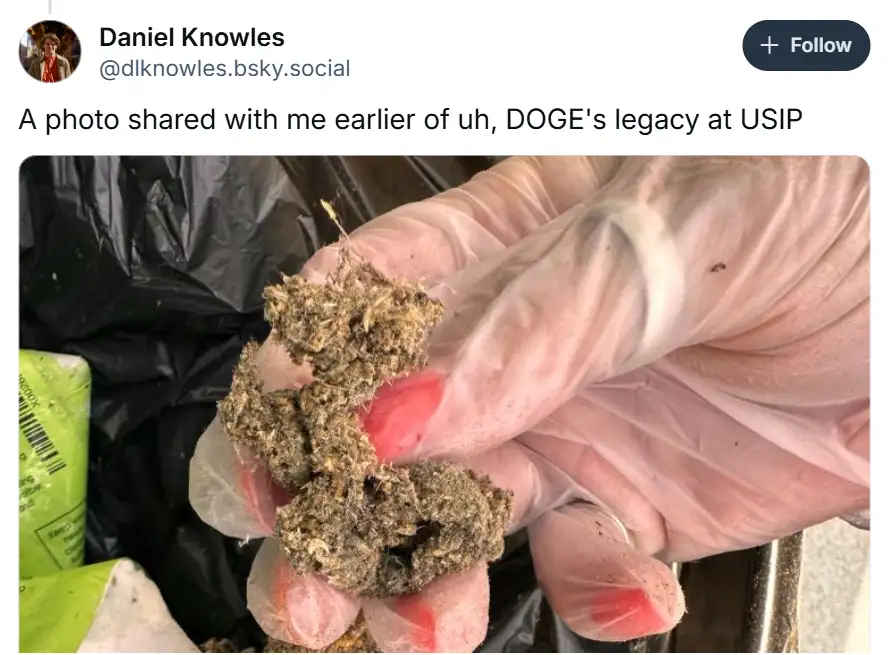
The discovery adds fuel to the fire of an already volatile situation, with USIP officials alleging that their building was forcibly occupied by DOGE in March 2025 and left in shambles by the time they regained control in May.
George E. Moose, acting president and CEO of USIP, submitted a sworn affidavit to a Washington, D.C., court detailing the shocking state of the premises. According to Moose, the building had suffered significant damage, including missing ceiling tiles, water leaks, a broken garage door, and even graffiti scrawled on outdoor surfaces.
“Among other things, they reported evidence of rats and roaches in the building. Vermin were not a problem prior to March 17,” Moose testified. He went on to describe the presence of a minimal cleaning crew that seemed powerless to address the growing mess left by DOGE’s operation.
Moose’s affidavit aligns with social media reports by former USIP staff and supporters, including a post by Keith Mines that described how the DOGE team’s first act was to dismantle the institute’s symbolic logo. Upon the building’s recovery, one of the first restorative acts was to reinstall the logo—an emblem of peace, diplomacy, and decades of bipartisan cooperation.